
What you can find on this page
Parents, whānau, service providers, leaders and educators all play an important role in supporting positive outcomes for children. Understanding the laws and regulations that apply to early childhood services can help everyone know what to expect and how services are expected to operate.
The laws and regulations that apply to early childhood services help support children's learning, care, health and safety. Understanding these requirements can be useful for people starting, running or working in a service, and for parents and whānau choosing education and care for their child.
This page provides an overview of the key legislation, regulations and licensing criteria that apply to early childhood education services. It includes information about the Education and Training Act 2020, requirements for licensed and certified services, and links to other relevant New Zealand legislation.
How do legislation and regulation fit together?
The legislation and regulations that apply to early childhood services work together in layers. The Education and Training Act 2020 provides the legal foundation for early childhood education in New Zealand. Under the Act sit the Early Childhood Education Regulations, which set the requirements services must meet to be licensed or certified.
The regulations are supported by licensing and certification criteria, which explain in more detail what services need to do in practice to meet those requirements. Guidance documents sit alongside the legislation and criteria to help services understand and implement them, but guidance is not part of the law and does not create legal obligations. It may instead describe best practice, or give more information about how services, or settings may meet the regulatory or legal requirements.
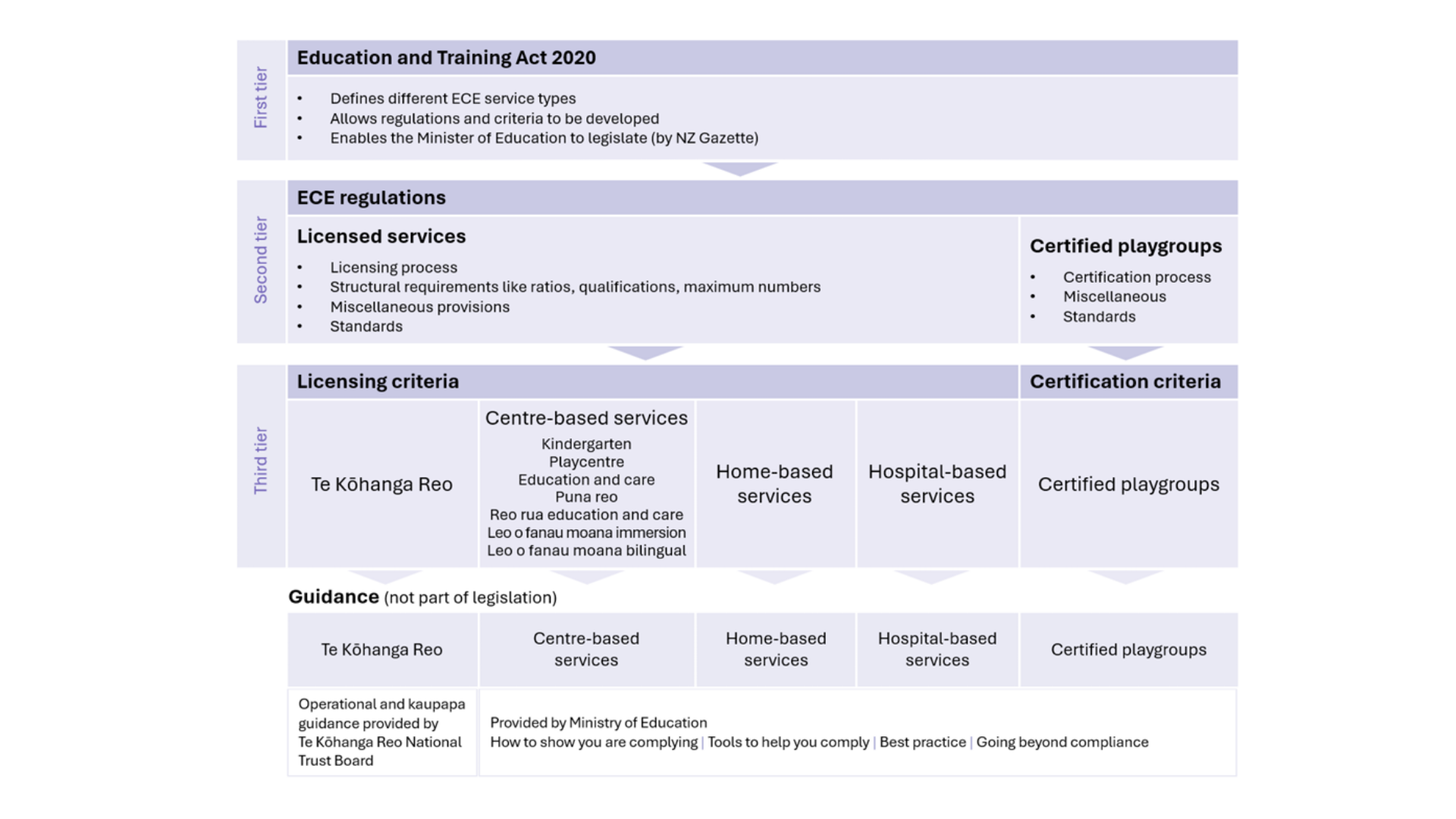
A range of laws, regulations and standards help ensure early childhood services provide safe, high-quality education and care for children. Some legislation sets out the overall requirements for operating a service, while other laws focus on specific areas such as child protection, health and safety, privacy, employment, transport, food safety and building requirements.
While not every law will apply in the same way to every service, understanding these requirements can help service providers, educators, parents and whānau understand the standards and expectations that support children's learning, wellbeing and safety.
What parents and whānau need to know
You don't need to be an expert in legislation to choose an early childhood service for your child. However, understanding some of the laws and regulations that apply to services can help you know what standards services are expected to meet and how children's learning, health, safety and wellbeing are supported.
While legislation and regulations can change over time, early childhood services are responsible for understanding and meeting the requirements that apply to them. Parents and whānau do not need to keep track of every change, but may find it helpful to stay informed about significant updates that affect their child's education, care, health, safety or wellbeing.
The information on this page may also help you think about questions you would like to ask a service, such as how it protects and supports children, communicates with families, responds to concerns, and continually improves the quality of education and care it provides.
Remember that legislation sets minimum requirements, and many services choose to go beyond these requirements as part of their commitment to providing high-quality education and care for children and mokopuna.
Regulations, licensing and certification criteria
Regulations
Early childhood education services regulations are part of the Education and Training Act 2020.
Education (Early Childhood Services) Regulations 2008 – New Zealand Legislation
Education (Playgroups) Regulations 2008 – New Zealand Legislation
Licensing and certification criteria
Criteria are used to assess compliance with the minimum standards set by the regulations.
Each type of early childhood service has different criteria.
Licensing criteria for centre-based education and care services
Licensing criteria for home-based education and care services
Licensing criteria for hospital-based education and care services
Licensing criteria for kōhanga reo affiliated with Te Kōhanga Reo National Trust
Early Learning Curriculum Framework – Te Whāriki
Te Whāriki provides the basis and context for the curriculum regulatory requirements in the regulations for all early learning services. The curriculum framework is set by the Minister of Education. The current framework was published in the New Zealand Gazette on 21 April 2023. More information on Te Whāriki is available on our curriculum website Tāhūrangi.
Child protection policies for early learning services
All early childhood education services must have a child protection policy. This is a requirement under the Children’s Act 2014 and helps ensure services have clear processes for supporting the safety and wellbeing of children.
A child protection policy should set out how the service works to keep children safe from abuse and neglect, and how concerns about a child's wellbeing will be identified, reported and responded to. Services must review their child protection policy at least every three years to ensure it remains effective and up to date.
Relevant legislation
Below you can find a list of the relevant legislation and links to where you can find more information
Focus | Name | Link | ||
General Education | Education and Training Act 202 | |||
Child Protection | Child Protection Act Part 2, Child protection policies | |||
Children’s worker safety checking | Children’s Act 2014, Part 3 Children’s worker safety checking | |||
Police vetting for non-children’s workers | Education and Training Act 2020, Schedule 4 | |||
Oaths and Declarations Act 1957 | ||||
Privacy/information sharing | Guidance | Sharing information to protect the wellbeing and safety of children and young people | privacy.org.nz | |||
Guidance | Information Sharing Guidance | Justice.govt.nz | Information Sharing Guidance | New Zealand Ministry of Justice | |||
Guidance | Information sharing | orangatamariki.govt.nz | Information sharing | Oranga Tamariki — Ministry for Children | |||
Privacy Act 2020 | ||||
Family Violence Act 2018, Part 2 Information sharing | ||||
Data and Statistics Act 2022 | ||||
Transport | Land Transport Act 1998 | https://www.legislation.govt.nz/act/public/1998/110/en/latest/ | ||
Land Transport Rules | ||||
Child Restraints | ||||
Health and Safety | United Nations Convention on the Rights of Persons with Disabilities | |||
Rights of Disabled People | ||||
Health and Safety at Work Act 2015 | Health and Safety at Work Act 2015 | New Zealand Legislation | |||
Health and Safety at Work (General Risk and workplace Management) Regulations 2016 | ||||
New Zealand Pandemic Plan | ||||
Evacuation Schemes – Fire and Emergency New Zealand | Evacuation Schemes and procedures | Fire and Emergency New Zealand | |||
Building/premises | Relevant bylaws of the local authority | |||
Building Act 2014, Issue of code of compliance certificate | ||||
Resource Management Act 1991 | ||||
NZS 5828:2015 | ||||
Teaching qualifications | Approved ITE programmes leading to teacher registration | |||
International Qualification Assessment (IQA) | Apply for an International Qualification Assessment (IQA) - NZQA | |||
Food safety | Food Act 2014 | |||
Food Regulations 2015 | ||||
Employment | Employment Relations Act 2000 |