
Strategic Intentions
Government departments publish strategic intentions to support accountability to Parliament. Strategic intentions inform Parliament and the public of what ERO's strategic objectives are over the medium-term, along with how we will manage our functions and operations to achieve or contribute to these objectives. Strategic intentions are part of a department’s regular performance reporting.
Strategic Intentions 2026-2030
These Strategic Intentions cover the period 1 July 2026 to 30 June 2030.
Published by the Education Review Office, New Zealand, June 2026.
Foreword
The Education Review Office plays an important role in New Zealand’s education system. We independently review, report on and provide regulatory services in early learning and schooling to support a fair, high-quality system where all children and young people can participate, progress and achieve.
Over the past three years, we have focused on strengthening the quality, consistency and clarity of our work. We have improved how we report on performance, built confidence in our evidence and insights, and become clearer about how our reviews, reporting, regulatory services and evaluations support improvement. This gives us a stronger foundation to play a more deliberate role in system-level change over the next four years.
This Strategic Intentions comes at a time of significant change for both the education system and for ERO. A major shift is the planned expansion of our regulatory role to include early childhood education, private schools and hostels. The legislation to enable this change is underway and if passed it will result in more than an increase in scope. For ERO, it means strengthening our capability, adapting our systems and ways of working, and bringing our review, insight and regulatory functions together so they operate as a more joined-up approach to improvement. If the legislation passes, we will update these Strategic Intentions to reflect this.
We are also moving to a more targeted, risk-based approach in schools. In the past, all schools have often faced similar compliance expectations regardless of performance. Over the next four years, we will reduce unnecessary compliance for providers consistently delivering high-quality education, while focusing more of our effort on areas of higher risk and where improvement is most needed. This will help us use our resources more effectively and strengthen our impact for learners.
Our work has both a direct and a system-wide role. We work with early learning services, schools and kura to assess quality, identify risk, support improvement and hold providers to account. We also bring together evidence from our reviews and evaluations to identify patterns, risks and priorities, and provide trusted insights to government, the sector, parents, whānau and communities.
Our contribution to Māori education is central to this work. Ka Hikitia – Ka Hāpaitia sets out how education agencies will work with services to achieve system shifts and support Māori learners and their whānau, hapū and iwi to achieve excellent and equitable outcomes. It emphasises both excellent outcomes and giving practical effect to Te Tiriti o Waitangi. These Strategic Intentions reflect that commitment.
The next four years will be important in determining whether the changes already underway lead to sustained system-level improvement. We will be more deliberate in where we direct our effort, more consistent in how we support improvement, and more transparent in how we report on quality and performance. We will focus our effort where it makes the most difference, using our resources effectively and efficiently to deliver on our intentions. Through this, we aim to support better education provision, stronger public confidence, and a more effective education system for all children and young people.
Tim Fowler
Acting Chief Executive and Chief Review Office
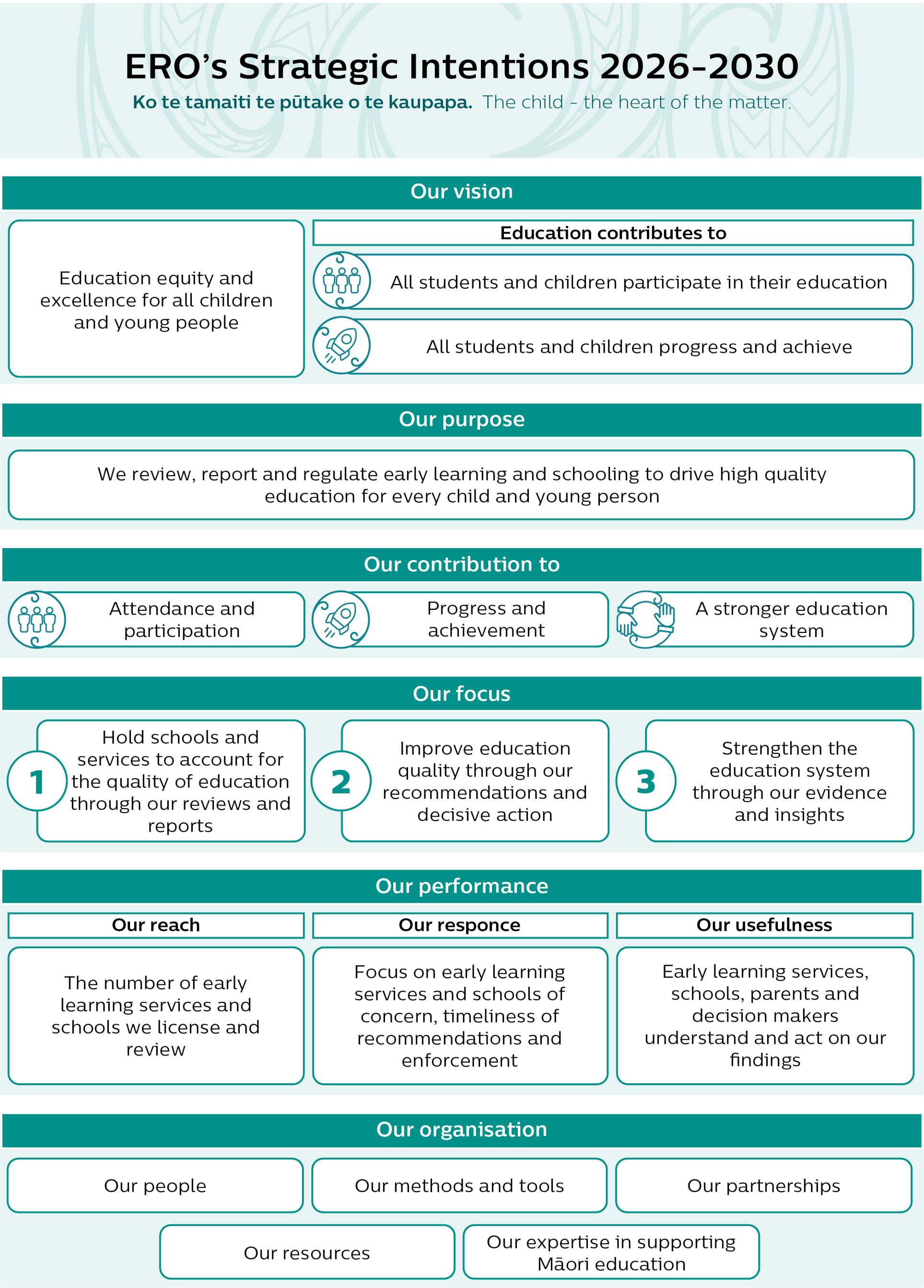
Our strategic framework: what we want to achieve
-
ERO Strategic Intentions 2026 2030 PDF | 1.30 MBDownload