
About early childhood education and care licences
Providing early childhood education and care services in New Zealand is regulated under the Education and Training Act 2020 (the Act) and the Education (Early Childhood Services) Regulations 2008 (the Regulations).
If you want to provide education and care to 3 or more children under the age of 6, you will likely need a licence.
There are 3 types of licensed early childhood services:
education and care services
home-based services
hospital-based services.
Being licensed means services are meeting our standards for education and care, including health and safety, curriculum, premises and facilities, governance and management, and child protection.
Who needs a licence
Early childhood education and care centres
If you want to provide this type of service, you will need a licence.
An early childhood education and care centre is defined in the Education and Training Act 2020 as premises used regularly for the education or care of 3 or more children (not being children of the persons providing the education or care, or children enrolled at a school being provided with education and care before or after school) under the age of 6:
by the day or part of a day, but
not for any continuous period of more than 7 days.
Starting a centre-based ECE service
Home-based education services
The Act says that “home-based education and care services and hospital-based education and care services may but need not be licensed”.
You will need a licence if:
you provide education or care to 3 or more children who are under 5 years of age, or who are 5 but not enrolled at school, for gain or reward
you provide the education or care in the:
children’s own home
home of the person providing the education or care
any other home nominated by a parent of the children.
Starting a home-based ECE service
If you are already operating as a licensed home-based or hospital-based service, you do not need a new licence to operate as an early childhood education and care centre.
Playgroups
Playgroups are not licensed, but they can choose to be certified. Playgroups only need to be certified if they want to receive government funding and support.
If you have a playgroup and you want to be certified, you will need to comply with 5 standards and the certification criteria.
Who does not need a licence
In most situations, you do not need an early childhood education and care licence if you are:
a registered school
a hostel
an Oranga Tamariki residence
a health or hospital institution run by the Ministry of Health or Health NZ
a hospital care institution
a children’s health camps funded by state services to provide education services
premises where all the children who are present are members of the same family and in the care of a family member or a caregiver who is not acting for gain or reward.
However, you will still need a licence if there are 3 or more children under the age of 6 who are the children of:
staff members
people attending the premises as residents or students.
Two hours per child per day
You do not need a licence if your premises is providing education or care to 3 or more children under 6 years old, but where each child stays no more than 2 hours a day.
Parents and caregivers must also be:
nearby
contactable
able to resume responsibility at short notice.
Examples of this type of short-term childcare are gyms or shopping malls, where parents/caregivers exercise or shop but are still close by.
There is no limit on how many 2-hour blocks can be provided across the week. An individual child can attend on different days (and for more than 4 hours across the week) if they are there for no more than 2 hours a day.
If you are providing this service, you must still comply with the requirements for limited attendance childcare centres under the Health and Safety at Work Regulations.
Four hours a week
You do not need a licence if your premises is providing education or care to 3 or more children under 6 years old for no more than 4 hours in a week. You can have the children for more than 2 hours if the weekly total is no more than 4 hours.
Parents and caregivers must also be:
nearby
contactable
able to resume responsibility at short notice.
An example of this type of service might be a church Sunday school session.
Decision flowchart
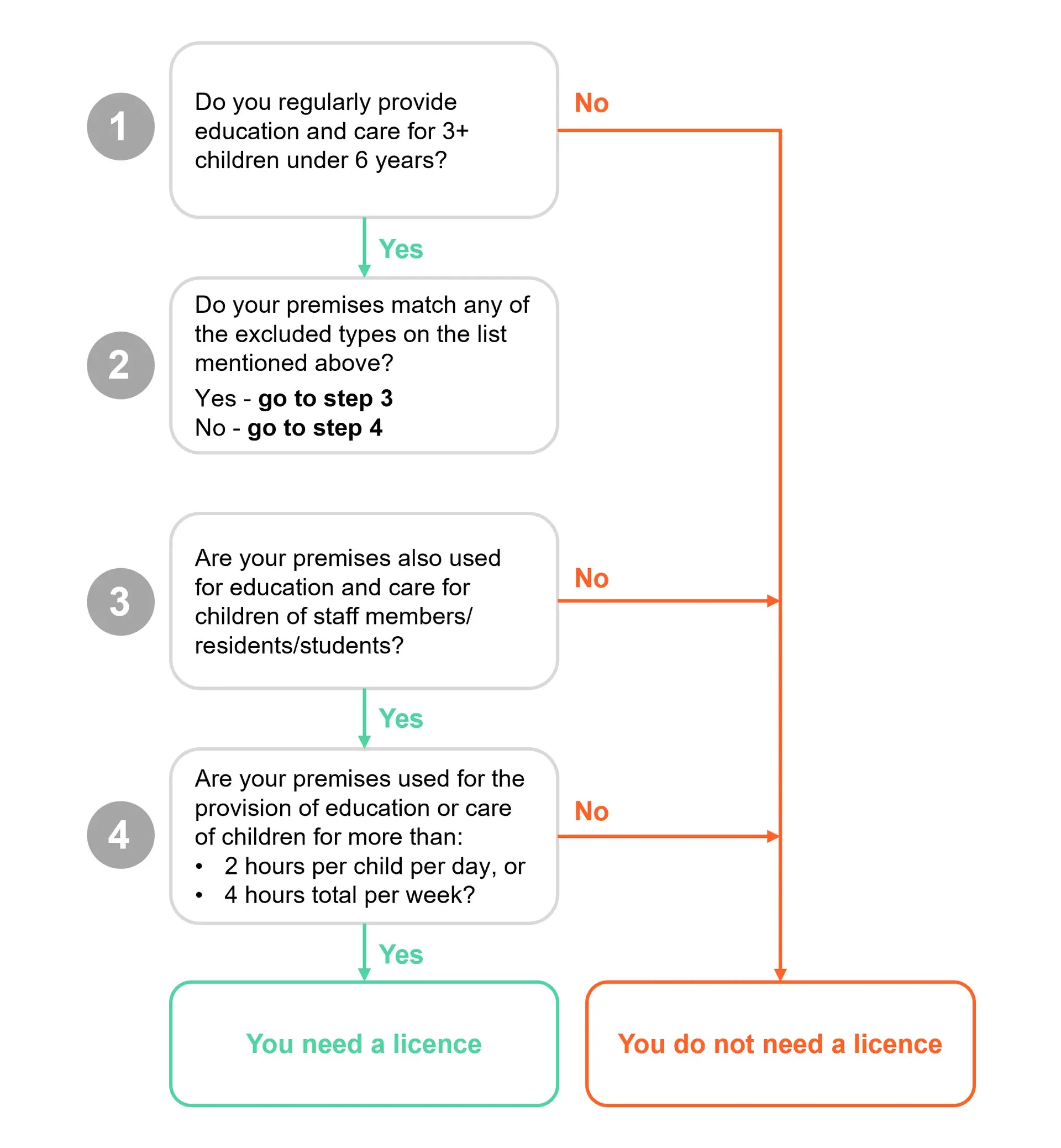
This decision‑making flowchart has 4 steps to help you determine if you need an early childhood service licence.
Step 1: “Do you regularly provide education and care for 3 or more children under 6 years?"
If yes, go to step 2.
If no, a licence is not required.
Step 2: “Do your premises match any of the excluded types on the list mentioned above?”
If yes, go to step 3.
If no, go to step 4.
Step 3: “Are your premises also used for education and care for children of staff members, residents, or students?”
If yes, go to step 4.
If no, a licence is not required.
Step 4: “Are your premises used for the provision of education or care of children for more than 2 hours per child per day, or more than 4 hours total per week?”
If yes, a licence is required.
If no, a licence is not required.